
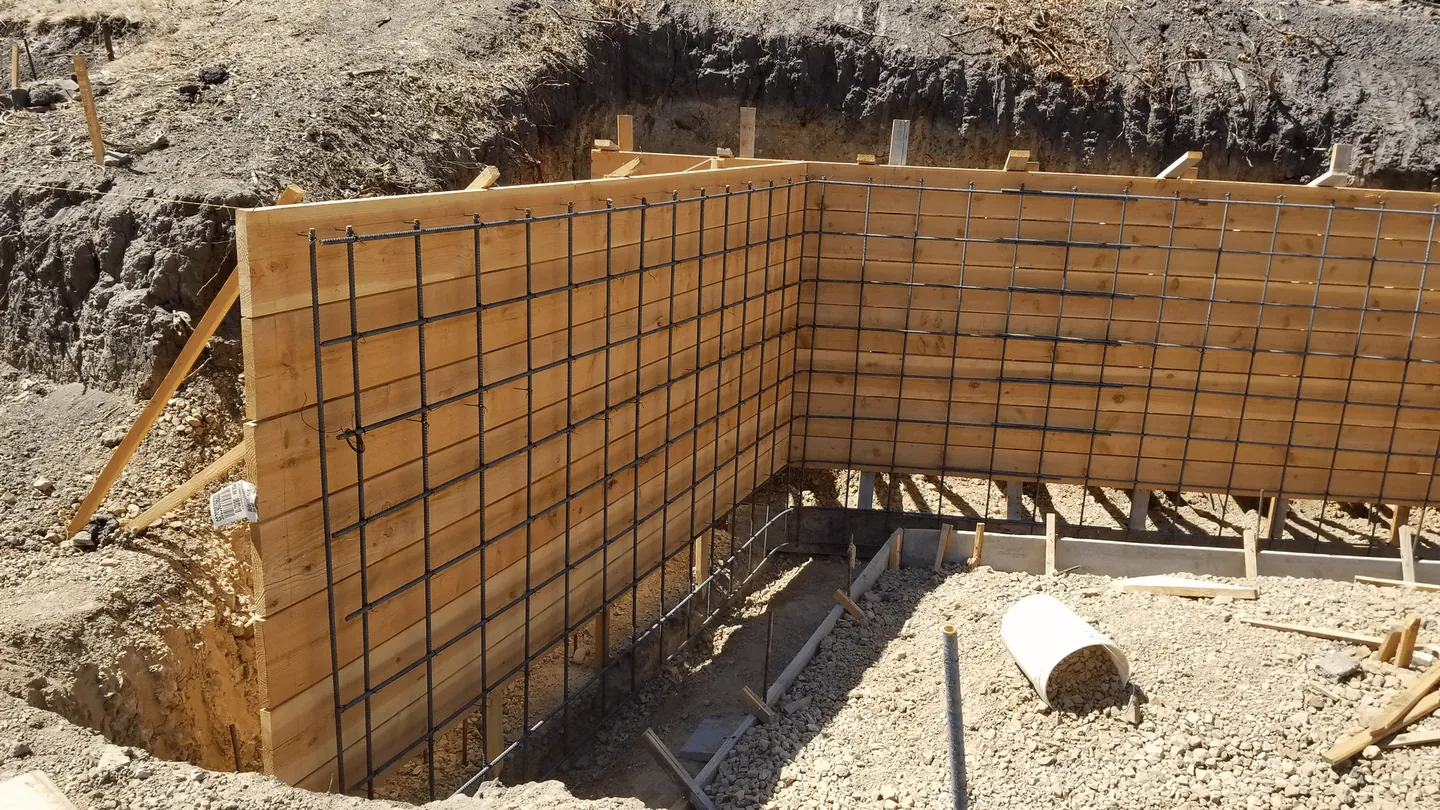
How Much Does a Retaining Wall Cost in Texas?
A national cost guide updated in 2026 puts a poured concrete retaining wall at about $20 to $40 per square foot of wall face. A second guide lists concrete walls at $20 to $55 per square foot, labor included. Square feet of wall face means the wall’s length times its height.
Measured along the ground, one guide puts retaining walls at about $40 to $345 per linear foot. Two guides put the national average project at $6,000 and $6,300. Bigger walls run well past that: in one guide’s table, a 100-foot wall 2 to 6 feet tall runs about $4,000 to $34,500.
These are market numbers, not our price list. We build poured concrete retaining walls tied to the dirt work behind them, and we put each quote in writing.
What are the market ranges for a retaining wall?
The table draws on two national cost guides updated in 2026. Poured concrete comes first because that is the wall we build. The block, stone and wood rows are market context only.
| Line item | Market range |
|---|---|
| Poured concrete, per square foot of wall face | $20 to $40 |
| Concrete walls, per square foot, labor included | $20 to $55 |
| Most retaining walls, per square foot | $20 to $53 |
| Retaining walls, per linear foot | $40 to $345 |
| Walls on a slope, per linear foot | $40 to $200 |
| A 100-foot wall, 2 to 6 feet tall | $4,000 to $34,500 |
| Steel rebar | $1.50 to $2.50 per square foot |
| Waterproofing | $2 to $10 per square foot |
| Excavation | $50 to $200 per cubic yard |
| Permit, national range | $40 to $450 |
| Interlocking block, per square foot (market context) | $15 to $35 |
| Natural stone, per square foot (market context) | $20 to $90 |
| Wood, per square foot (market context) | $13 to $35 |
Few walls use every line. A short wall with easy access may need little beyond the wall and its drainage. A tall wall cut into a slope can use them all.
The guides are national, and none of them prices Texas alone. Height, the footing, drainage, the soil and the permit decide where a Texas wall lands.
Why does height move the price so much?
Height drives the price twice. A wall twice as tall has twice the face, so the square foot math doubles. A taller wall also holds back more soil, and that changes what the wall needs.
One national guide says higher walls need a stronger base, more drainage and more excavation. It adds that they often require more planning and engineering. On a poured concrete wall, the base is the footing, the buried concrete the wall stands on.
Steel climbs with height too. Another guide notes that concrete walls, and walls over 4 feet, typically get steel rebar. It prices rebar at about $1.50 to $2.50 per square foot.
When a wall needs an engineer’s design, the design fee is part of the cost. The cost guides give no figure for that fee, so ask whether a quote includes it.
What does Fort Worth require for a taller retaining wall?
The City of Fort Worth requires a permit for a retaining wall taller than 4 feet. The city measures from the bottom of the footing to the top of the wall. So the buried footing counts toward the 4 feet, along with the part you can see.
That rule comes from the city’s residential permitting page. On a commercial site, the city permit office says what the plans for a wall need. One national cost guide lists permits at about $40 to $450, and the city sets its own fee.
Digging the footing brings in state law too. Texas law says the excavator notifies Texas 811 at least 48 hours before digging starts, weekends and holidays aside.
How do drainage, excavation and backfill add up?
A retaining wall needs a way to drain water from behind it. One national guide lists gravel, backing and drain materials for that job. On a poured concrete wall, drainage stone and pipe go in behind the wall before the backfill.
Excavation comes first. An excavator digs the cut for the footing, plus working room behind the wall. One guide puts excavation at about $50 to $200 per cubic yard.
Backfill closes out the wall. One guide notes that fill goes back behind the wall and is often available on site. It goes in lifts, thin layers, with each lift compacted before the next.
Waterproofing is a line of its own. Two guides put it at about $2 to $10 per square foot of wall.
Access counts as well. An excavator and a concrete truck both need a path to the wall. A tight site behind a building or at the foot of a steep slope can mean smaller machines and more hours.
Why does North Texas clay raise the price?
Clay swells when it gets wet and shrinks as it dries. The federal soil survey describes Sanger soils, which formed in clayey marine sediments, as high in shrink-swell potential. They are found mainly in the Grand Prairie of north-central Texas.
In dry periods, Sanger soils crack 1/2 to 3 inches wide at a depth of 12 inches. A national cost guide flags clay too. It says clay soil can be very problematic and expensive, and that walls built on clay often need extra reinforcement. On clay, ask how the design handles the drainage behind the wall.
A retaining wall often holds the cut for a building pad on a slope. That pad is site preparation work, and it is priced on its own lines.
What should a written quote for a retaining wall cover?
Two wall quotes only compare when they name the same work. Ask each one to list these pieces:
- The wall’s length and height, and where the height is measured from
- Excavation for the footing and working room behind the wall
- The footing, the wall and the steel inside them
- Drainage stone and pipe behind the wall
- Backfill placed in lifts, with each lift compacted
- Waterproofing, if the design calls for it
- The engineer’s design and the permit, where the wall needs them, and who pays for each
- How the machines and the concrete trucks reach the wall
- Where the extra dirt from the cut goes
Retaining walls are one part of our concrete work, beside foundations, stem walls and drainage structures.
What is the next step for a retaining wall in Texas?
Call or text (214) 557-5106 with the wall’s rough length and height, and photos if you have them. We look at the job and put the quote in writing. Read more about our poured concrete retaining walls.